Kids as Young as 8 Are Building Hurricane Melissa Relief AI Across 5 Countries
The Genius Project's newest challenge points real AI at a real problem. Teams across five Caribbean countries, with the youngest builder just 8 years old, are using computer vision, machine learning, satellite analysis, mesh networks and local language models to get the region ready for hurricane season.
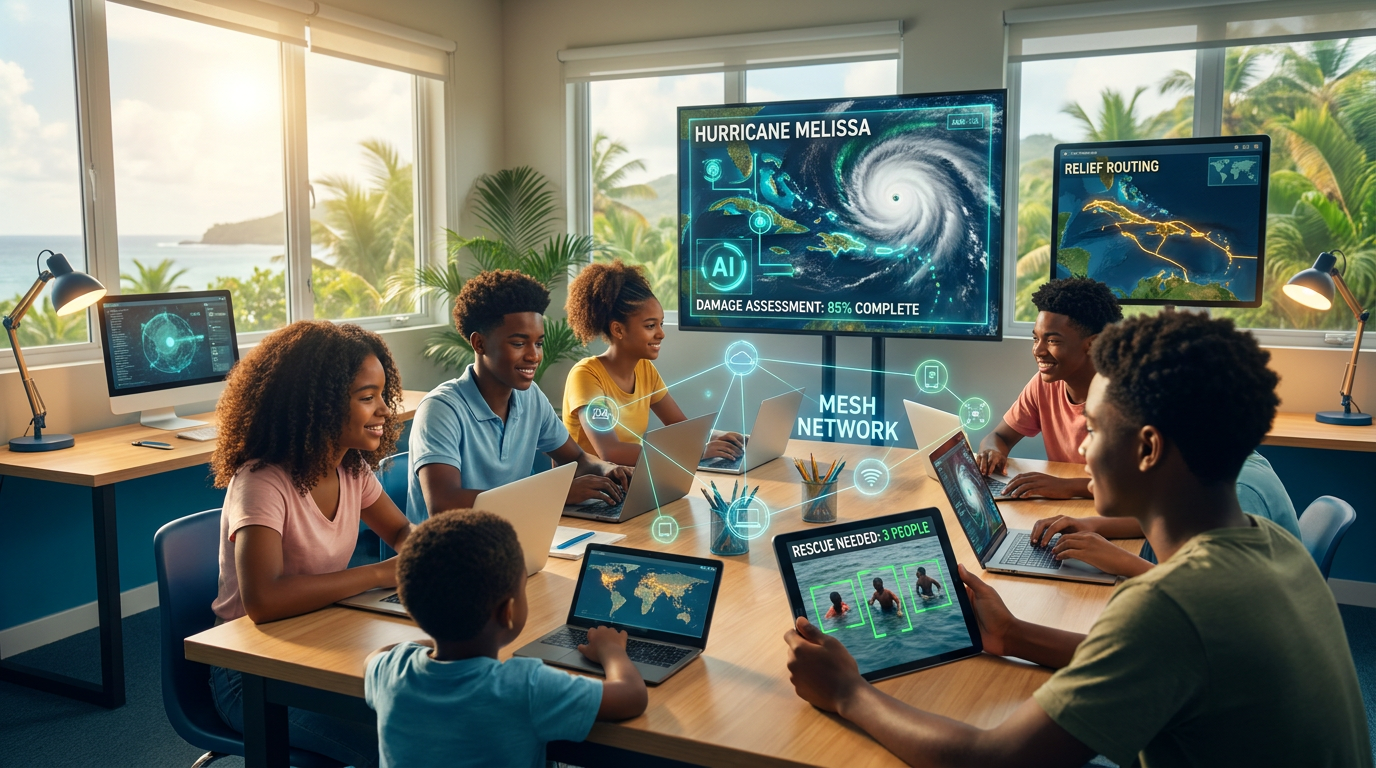
Hero illustration generated with Runway.
- The Genius Project has launched a new Hurricane Melissa challenge in which teams of young people build working disaster-relief AI, not slideshows about it.
- The cohort spans five Caribbean countries, and the youngest builder on the teams is 8 years old, working alongside older teens.
- Teams are using computer vision for emergency rescue, machine learning to route relief where it is needed, AI analysis of satellite imagery to assess damage and road restrictions, mesh networks for when normal connectivity fails, and local LLMs paired with video AI and a knowledge base to guide people in need.
- Every prototype is a coordination tool, not an emergency service. Life-threatening cases go to official responders, and every AI match passes through human verification.
- The point of building now, before a storm, is to have the thinking, the data handling and the safety rules worked out in advance, so the region is genuinely more ready for hurricane season.
The most striking thing in the room is not the technology. It is who is building it. On one of the teams, the youngest member is 8 years old. She is not fetching snacks or holding a clipboard for the older kids. She is arguing, correctly, that a person trapped after a storm should not have to type their full address into a form before the app will help them, because in that moment they may not know exactly where they are and their battery is dying. That is product thinking. It happens to be coming from a third-grader.
This is The Genius Project's newest challenge, and it is built around a name the region already knows: Hurricane Melissa. Instead of teaching AI in the abstract, we handed teams of young people a problem their own families understand in their bones, then asked them to build something real. Across five Caribbean countries, teams are using machine learning and generative AI to solve genuine relief problems and, in plain terms, to get us ready for hurricane season before the next major storm arrives rather than during it.
A New Feature, Built Around a Real Storm
The challenge is a new addition to The Genius Project, and it works differently from a normal lesson. Every team builds its own version of the same core idea: a relief tool that helps people affected by Hurricane Melissa figure out what support they need and connects them with the right help. Teams run a build sprint, produce a working prototype, and present a short demo that is judged on usefulness, reasoning and safety, not on how pretty the interface looks.
That last point matters more than it sounds. A polished screen is not proof that an application works. So before any team opens a builder, they answer a short set of hard questions: who is the user, what is the problem, what information does the app actually need, what decision will the system make, what does the user receive, how could it fail, and where does a human stay in the loop. A team that cannot answer those cannot build. It is the same discipline a professional AI team uses, scaled down to fit a room that includes an 8-year-old and a sixteen-year-old on the same project.
🧠 Why an 8-year-old belongs on an AI team
It is easy to assume the youngest child in the room is there to observe. That misreads how building actually works. The hardest part of a relief tool is not the code, it is deciding what a frightened, exhausted person can realistically do in the first thirty seconds of using it. Younger builders are often better at that than adults, because they have not yet learned to accept complicated interfaces as normal. When an 8-year-old says a step is confusing, she is usually right, and she is describing exactly the user the tool has to serve.
Mixed-age teams also change how learning sticks. Older teens who have to explain a machine learning idea to a younger teammate in words that land end up understanding it far better themselves. Teaching a concept is one of the strongest ways to actually learn it, and the challenge is deliberately structured so that no feature gets added until someone can explain, out loud, why it is necessary.
Learning by teachingBeginner's clarityProduct empathy
The Five Techniques the Teams Are Working With
This is not one app repeated five ways. Across the cohort, teams are reaching for different pieces of real AI and systems engineering, each aimed at a specific failure that happens during and after a major hurricane. Here is what they are actually building with.

1. Computer vision for emergency rescue
One set of teams is using computer vision, the branch of AI that interprets images and video, to help locate people who need rescue. The idea is to take footage from a phone, a drone or a fixed camera and have the system flag likely people, damaged structures or hazards, so a limited number of responders can look at the highest-priority frames first instead of scrolling through hours of raw video. The AI does not decide who gets saved. It narrows a mountain of footage down to the parts a human should look at now.
2. Machine learning to route relief
Getting supplies to people is not just a driving problem, it is a matching problem. Another group is using machine learning to route needed relief: taking in where requests are coming from, what is being asked for, how urgent each case is and what supplies exist where, then suggesting how to move food, water, medicine and materials so the most urgent, reachable needs are met first. In a real storm, guessing wrong means a truck of water sits in the wrong town while another runs dry. The model's job is to make that guess far less often.
3. Satellite imagery analysed with AI
After a storm, nobody has a clear map of what actually happened. Teams here are using AI to analyse satellite images to assess damage and identify road restrictions: which areas took the worst hit, which routes are flooded or blocked, and where responders simply cannot get through yet. Turning a fresh satellite pass into a usable "these roads are open, these are not" picture in minutes rather than days is the difference between relief that reaches people and relief that gets stuck at a washed-out bridge.
4. Mesh networks for when the towers go down
The cruel part of a hurricane is that it knocks out the very communication people need most. One track is working with mesh networks, where devices connect directly to one another and pass messages along a chain, so a phone can still reach help even when cell towers and home internet are down. A request can hop device to device until it reaches someone who is back online. It is a reminder that disaster tech goes beyond AI: the smartest model is useless if the grid fails and nobody can reach it.
5. Local LLMs with video AI and a knowledge base
The final piece is guidance. Some teams are building local large language models, AI assistants that run on a device without needing a constant internet connection, paired with video AI and a curated knowledge base, to give people in need clear, calm instructions. Think of a resident who needs to know how to purify water, treat a wound, or shut off a gas line, getting a plain-language answer, and where useful a short video, from an assistant that keeps working when the connection does not. The knowledge base keeps the answers grounded in vetted, local information rather than whatever the model happened to memorise.
Where the teams are
Source: The Genius Project Hurricane Melissa challenge cohort, 2026. Team counts are illustrative of the current spread across the five participating countries.
Safety Is Not the Boring Part, It Is the Point
It would be easy for a young team to build something that looks heroic and quietly does harm: an app that tells a family help is on the way when nobody has actually confirmed it, or that publishes a stranger's home address to the whole internet. So the challenge bakes safety in as a graded requirement, not an afterthought. Every prototype has to carry a clear warning that life-threatening emergencies go to official emergency services. Every match or recommendation the AI makes has to be treated as a suggestion until a human verifies it. And teams have to name at least three ways their tool could fail, each paired with a safeguard.
This is where the challenge doubles as governance training. Data retention, who can see a request, bias in an automated priority list, and accountability when an AI system gets something wrong are exactly the questions the Caribbean AI Risk Management Council works on for real organisations. Teaching a 14-year-old to ask "what happens if this information is wrong or dishonest?" before shipping a feature is the habit that separates a useful tool from a dangerous one, not a nice extra.
Why Build It Before the Storm
The worst possible time to design a relief tool is in the middle of the emergency it is meant to serve. Adrenaline is high, information is scarce, and every shortcut taken under pressure becomes a permanent flaw. Building and stress-testing these ideas now, before hurricane season peaks, means the reasoning, the data handling and the safety rules are worked out while there is time to get them right.
There is a second reason, and it is the one that matters most for the young people involved. A generation that grows up treating AI as something that happens to them, decided elsewhere and delivered finished, is a generation that stays a customer. A generation that points machine learning and generative AI at a hurricane, the single most defining threat their region faces, and builds a real answer, is a generation that becomes a builder. Across five countries, that is the shift this challenge is designed to produce, one mixed-age team at a time, starting with an 8-year-old who already knows a good app should ask for less, not more.
Related reading across the Caribbean AI network
- StarApple AI: The Caribbean's first AI company, based in Jamaica
- Adrian Dunkley, the AI Boss: Founder of StarApple AI and The Genius Project
- AI Jamaica: Coverage of Jamaica's national AI programmes and policy
- Caribbean AI Association: Regional policy and adoption tracking across CARICOM
- Caribbean AI Risk Management Council: Governance, data risk, and accountability frameworks for AI systems
- AI Trinidad & Tobago: AI adoption and infrastructure news from Trinidad and Tobago
- AI Barbados: Barbados-focused AI education and policy coverage
- AI Guyana: AI development and youth programmes in Guyana